The feel of the thing
Specs get you close. Your hands decide.
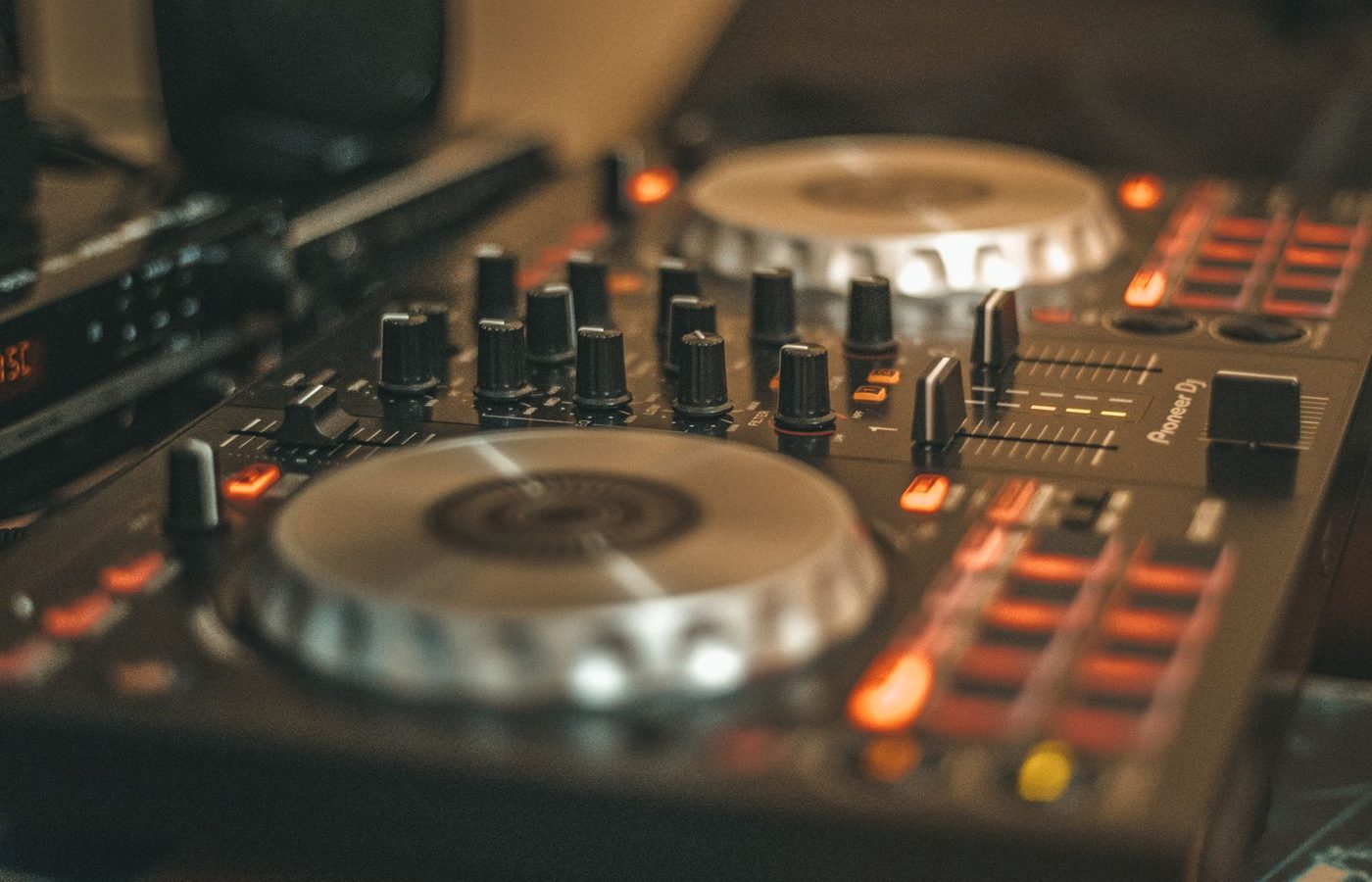
A controller is muscle memory in a box — jog wheels, faders and pads you'll touch ten thousand times. Once you've narrowed the list, get your hands on one if you possibly can.
Ignore the spec-sheet arms race. Nearly every good buying decision comes down to these four things. Answer them honestly and the right controller almost picks itself.
The best controller is the one you'll actually buy and use — not the one that wins on paper. Decide the number first; it does most of the filtering for you. A good beginner unit starts around £89.
Controllers are married to their app. Rekordbox is the Pioneer/club standard, Serato rules scratch & open-format, Traktor is loved for stems and techno, djay is the iPad-friendly all-rounder. Not sure? Pick a unit that runs two.
Most controllers need a laptop to run. Standalone gear plays straight off a USB stick or internal drive with nothing else plugged in — more freedom and reliability, but you pay for it.
Bedroom fun, mobile gigs & parties, club sets & going pro, or scratch & battle? Where you're headed matters more than any feature. Buy for the next 18 months, not a fantasy five years away.
Answer those four questions interactively and get a single, reasoned recommendation weighted toward value — not the dearest box on the shelf.
Grouped by what you'll really pay in the UK (street prices, mid-2026 — they drift, so always check before you buy). Each card shows the software, whether it runs without a laptop, the channel count and who it's genuinely for. Green = plays standalone.
A controller is muscle memory in a box — jog wheels, faders and pads you'll touch ten thousand times. Once you've narrowed the list, get your hands on one if you possibly can.
A controller is only as good as the software it's welded to. Here's what each ecosystem is genuinely best at — pick the world you want to live in, then buy hardware that speaks it.
Pioneer/AlphaTheta's own app, and the software behind the CDJ-3000/DJM booths in nearly every club. Prep at home, play anywhere. Free tier is generous.
Rock-solid and the home of scratch, hip-hop and open-format. Serato DJ Lite is free; Pro unlocks the lot. The default for battle DJs and weddings.
Native Instruments' app, loved for remix decks, stems and deep FX. Traktor Pro 4 rewards tinkerers and electronic-music heads who build sets like productions.
Algoriddim's djay runs on Mac, iPhone and iPad with Neural Mix stems and Apple Music access. Cheap, friendly, brilliant for starting on a tablet.
This is the fork in the road that decides how much you'll spend. Neither is "better" — they're different tools for different DJs.
Why standalone "bridges to the club": every real club booth is standalone — CDJs and a mixer, no laptop in sight. Learning on a standalone unit like the XDJ-RX3 or XDJ-AZ means the workflow you practise at home is the exact one you'll face on the night. That said, if you'll always have your laptop with you, a laptop controller does everything — spend the saved money on better tunes and a proper pair of headphones instead.

Whether the brain lives in a laptop or inside the deck, the moves you learn are identical — beatmatching, EQ, phrasing. Pick the workflow that keeps you practising, not the one with the longest spec sheet.
Here's the secret the spec sheets won't tell you: the skills matter far more than the box. Beatmatching, phrasing, EQ, gain, harmonic mixing — they're identical on a £89 Party Mix and a £2,000 CDJ-3000 setup. The controller is just the training ground.
Start on whatever fits your budget. Master the fundamentals — they're the same everywhere and they never expire. The gear is only half the job.
Every knob and fader on your controller has a twin in the club booth. Once you see the mapping, walking up to a CDJ-3000 and DJM-V10 stops being scary.
Move to standalone (XDJ-RX3/AZ) or straight to CDJs when the gigs come. The muscle memory transfers 1:1 — nothing to unlearn.
The DDJ-FLX4 has launched more DJ careers than any flagship ever made. Don't blow the budget on four channels and motorised platters you can't yet use — get the skills first, upgrade when a real reason appears.
A controller marries you to its app. If you're not certain, buy a dual-software unit (the FLX4, FLX6-GT, GRV6 and FLX10 all run Rekordbox and Serato). Try both worlds before you commit — switching later means relearning muscle memory.
A cheap controller with great tunes and clean beatmatching beats an expensive one played badly, every time. If you're torn between spending more on hardware or on music and decent headphones — pick the music and headphones.
Sixty seconds, seven honest questions, one reasoned recommendation matched to you — weighted toward value, never toward the priciest box.
The bit that actually moves you on is someone stood next to you saying “that’s why it slid.” I teach one to one in King’s Lynn on the real thing — Pioneer CDJ-3000X, a DJM-V10-LF and Technics 1210s — not a controller you’ll never see in a booth.
Not near Norfolk? Nothing here goes behind a paywall — carry on through the free lessons.